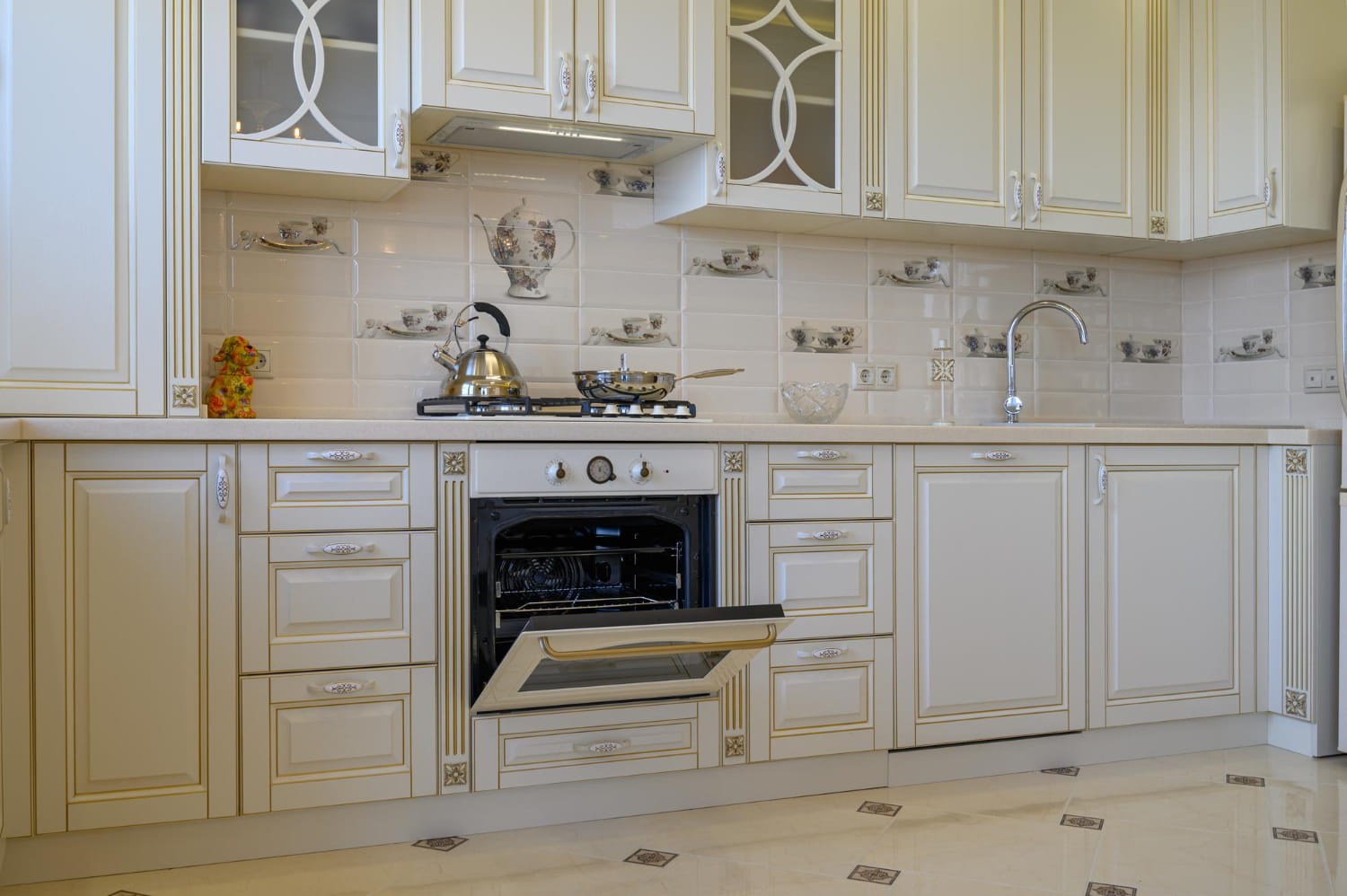
Cabinets account for the largest share of a kitchen’s visual identity. Before the countertops go in, before the hardware gets chosen, the cabinet style already sets the tone for everything else. The wrong choice creates friction that no amount of accessorizing fixes.
So we created this guide to walk you through eight kitchen cabinet styles that consistently deliver in modern homes, with specific context on what makes each one work, where each belongs, and what separates a good fit from a great one.
Key Takeaways
- Shaker remains the most adaptable kitchen cabinet style available, but the 2026 slim shaker variation gives the classic look a noticeably sharper profile.
- Flat-panel cabinets live or die by finish selection; the door profile alone won’t carry the design.
- Inset cabinets signal custom-quality craftsmanship before a single door opens.
- Raised panel has a reputation problem that careful pairing can fix.
- Glass-front cabinets perform best as architectural punctuation, placed selectively rather than spread throughout.
- Two-tone cabinetry follows specific rules of contrast and anchoring; skipping them shows.
- Natural wood in 2026 looks nothing like the wood kitchens of two decades ago.
- Fluted and beadboard surfaces bring textural depth exactly where a kitchen full of flat doors needs it most.
1. Shaker Cabinets
Shaker is the most widely used kitchen cabinet style for one clear reason: it works across nearly every context. Built around a five-piece door with a recessed center panel and clean, straight rails, the construction is both structurally sound and visually flexible. The same profile that suits a farmhouse kitchen pairs just as naturally with a sleek coastal remodel or a transitional space.
Designers reach for it often because it gives clients a finished look without locking the rest of the design into a single aesthetic direction.
For 2026, the slim shaker variation is worth noting. Its frame sits at roughly half an inch wide, producing a lighter silhouette without losing the character the style is known for.
Popular modern pairings:
- Sage green or navy with brushed brass hardware, for coastal and transitional kitchens.
- Warm white with matte black pulls, for a clean contemporary finish.
- Natural oak stain with stone countertops, for a textured, organic feel.
2. Flat-Panel (Slab) Cabinets
For homeowners who prefer clean geometry over decorative detail, flat-panel is one of the most direct kitchen cabinet options available. One uninterrupted surface: no frame, no recess, no ornamentation. In contemporary, Scandinavian, and minimalist kitchens, that restraint reads as deliberate and polished.
The finish drives the visual result more than the door shape itself. Matte surfaces absorb light and create a grounded, calm feel. High-gloss finishes reflect it, making a compact kitchen feel more open, but they show fingerprints readily. Wood veneer on a slab door adds warmth without any structural framing detail.
In 2026, matte and semi-matte factory finishes are leading new slab installations, with anti-fingerprint coatings becoming standard on painted options.
These cabinets pair cleanly with handleless hardware or push-to-open mechanisms, keeping the door surface continuous from top to bottom.
Where this style underperforms:
- Homes with traditional, craftsman, or farmhouse architecture.
- Kitchens where warm texture is needed to balance hard, cool surfaces.
- Spaces where the surrounding palette is already flat and cold.
3. Inset Cabinets
Inset cabinets have doors and drawer fronts that sit inside the cabinet frame rather than over it. The result is a flush, seamless surface that looks custom-built from the start.
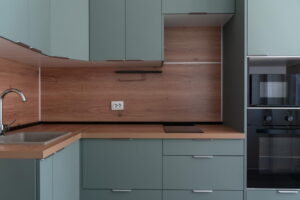
The construction requires tighter tolerances than standard overlay cabinets. Every door needs precise fitting so it hangs flush without gaps or binding, which is why skilled installation and quality materials are non-negotiable. That precision is also why inset cabinets cost more.
Among the styles of kitchen cabinets at the premium end of the market, inset is one of the few that genuinely reads as custom from across the room.
Two ways to use inset:
- Slab inset: Clean, frameless look with a flush surface; pairs well with transitional and contemporary kitchens.
- Framed inset with shaker doors: Combines classic structure with a refined, built-in finish; common in elevated coastal and traditional homes.
The payoff is longevity. Inset cabinets hold their appearance well as wood naturally adjusts to humidity and temperature over time.
4. Raised Panel Cabinets
Raised panel is one of the types of kitchen cabinets most often written off as dated, but that reputation comes from poor execution rather than the design itself.
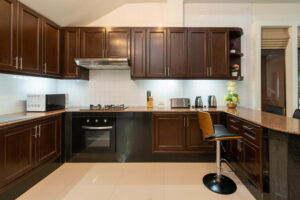
A raised panel door in a dark stain, surrounded by ornate crown molding and a busy backsplash, reads as an older kitchen. The same door in a soft white or warm neutral, paired with clean stone countertops and understated hardware, reads as a deliberate traditional choice.
The panel detail adds genuine depth and shadow lines to the door surface. Let that carry the visual weight, and keep everything around it calm.
Hardware selection is decisive here. Clean pulls in brushed nickel or unlacquered brass let the door detail exist without competing with it. Ornate knobs or bin pulls tip the design toward heavy rather than refined.
Where this cabinet style belongs:
- Colonial, craftsman, and Tudor-style homes where the architecture calls for traditional detail.
- Formal kitchens connected to dining rooms with traditional millwork.
- Homeowners who want a visible door texture without ornate carved detailing.
5. Glass-Front Cabinets
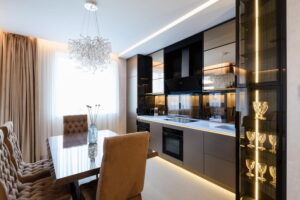
Glass-front is a kitchen cabinet style built around visibility. The glass panel replaces a solid door, giving a partial or full view into the cabinet interior.
However, you should keep in mind that what’s inside will be seen. Homeowners who get this right treat those cabinets as intentional display space. Stacked white dishware, matching glassware, and curated ceramics read well. Mixed containers and everyday clutter do not.
Glass types and their effect:
| Glass Type | Visual Effect | Best Use |
| Clear | Full visibility | Uniform dishware, glassware |
| Frosted | Soft, diffused silhouette | Mixed storage, minimal staging |
| Smoked | Dark, textured opacity | Accent doors, moody palettes |
| Seeded | Antique texture, partial view | Farmhouse and traditional kitchens |
Adding LED strip lighting inside shifts these cabinets from functional to architectural. Using two or three doors in a run, rather than an entire kitchen, lets them break visual monotony without creating noise.
6. Two-Tone Cabinets
Two-tone cabinetry uses different colors or finishes across cabinet zones, most often upper versus lower cabinets, or the island versus the perimeter.
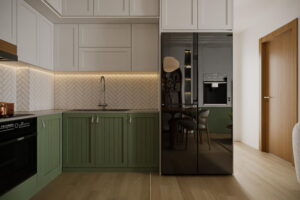
The contrast creates visual hierarchy. A lighter upper zone keeps the ceiling feeling open. A deeper, lower tone grounds the space without making it feel heavy.
Combinations that read well together:
- Warm white uppers with deep navy or forest green lowers.
- Greige perimeter with a natural oak or walnut island.
- Matte black island against a neutral painted perimeter.
The design requires one visual anchor. When two distinct tones share a kitchen, the hardware finish, countertop edge, or flooring needs to tie them together. Without that thread, the contrast reads as unfinished rather than deliberate.
The most common mistake is choosing colors that are close but not complementary, like a greyed blue against a greened blue. The difference needs to be clear enough to read as intentional from across the room.
Two-tone performs better in larger kitchens. In compact spaces, competing tones can make the layout feel fragmented rather than layered.
7. Natural Wood Cabinets
Natural wood cabinets in modern homes are not the honey-toned or dark-stained versions that defined kitchens in older remodels. The current version uses white oak, walnut, and maple with clear or matte sealants that let the grain show without adding a color cast.
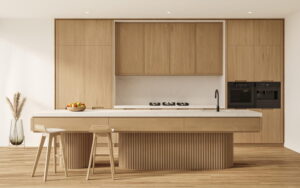
The appeal is texture. Wood grain brings something painted cabinets cannot: a surface that reads differently in morning light than it does in the evening.
Grain direction adds another layer of control. Vertical grain draws the eye upward, making standard cabinet heights feel taller. Horizontal grain reads wider, which suits kitchens with lower ceilings.
Material and pairing guidance:
- White oak: Pale, neutral grain; pairs with quartzite, marble, and warm stone countertops.
- Walnut: Darker, richer tone; needs generous natural light to avoid feeling heavy.
- Maple: Fine, even grain; the most adaptable wood if a hybrid painted finish is planned.
Among kitchen cabinet options that prioritize texture over decoration, natural wood carries one practical consideration: high-moisture zones near the sink and dishwasher need sealed edges and proper finishing to prevent swelling over time.
8. Beadboard and Fluted Cabinets
Beadboard and fluted cabinets are both texture-forward door styles, but they come from different design traditions and suit different kitchen aesthetics.
Beadboard features rows of vertical grooves pressed into the door panel. It reads as cottage, farmhouse, or coastal, and pairs well with shaker-style perimeter cabinets for a layered, character-rich kitchen.
Fluted cabinets use rounded vertical channels machined directly into the door surface. The result is sculptural rather than rustic, which is why fluted doors appear more frequently in high-end contemporary and transitional remodels.
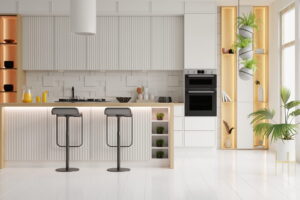
Both styles share one rule: use texture selectively. An island base, a pantry door, or a single accent cabinet run gives the surface enough visual presence without pulling the eye in too many directions. Applied throughout an entire kitchen, the texture stops reading as a design choice and starts reading as noise.
Strong pairings by application:
- Fluted white oak island base with flat-panel perimeter cabinets.
- Beadboard pantry door alongside shaker upper cabinets.
- Fluted lower cabinets with open shelving uppers in a coastal kitchen.
What Types of Kitchen Cabinets Can You Mix?
Yes, mixing door styles is an option — but it requires a shared thread running through both.
The combinations that read well are built around one consistent detail: a hardware finish, a countertop material, or a flooring tone that ties the two styles together visually. Without that, mixed styles look like leftover decisions rather than a considered design.
Combinations that hold together well:
- Shaker perimeter cabinets with a flat-panel island.
- Glass-front upper cabinets with shaker or inset lowers.
- Fluted island base with flat-panel or natural wood perimeter cabinets.
Limit the mix to two kitchen cabinet styles per kitchen. Three or more creates visual competition that matching hardware alone can’t resolve.
The goal is deliberate contrast, not variety for its own sake. If the reason for mixing isn’t immediately clear from across the room, simplify.
Every kitchen is different, and the right cabinet style depends as much on your home’s architecture as it does on personal preference. If you’re working through a remodel in Orange County and want a clearer picture of what would fit your space, we’re happy to help.
Our kitchen remodeling consultations start on-site, so we can look at the layout, the light, and the details that a screen can’t capture.
FAQ
1. What is the most popular kitchen cabinet style for modern homes right now?
Shaker remains the top choice across both traditional and contemporary kitchens, largely because the door profile adapts to almost any finish or hardware selection.
2. Are two-tone cabinets still relevant, or are they fading out?
Two-tone is still a strong choice in larger kitchens where the contrast has room to read clearly. In compact spaces, it often creates more visual tension than intended.
3. How do the styles of kitchen cabinets you choose affect home resale value?
Timeless options like shaker and inset tend to hold value better than trend-specific choices. Buyers respond well to cabinets that feel neutral enough to work with a range of finishes and layouts.
4. Which cabinet door styles suit small kitchens with limited natural light?
Flat-panel cabinets in matte white or light greige keep the space feeling open. Avoiding heavy door profiles and dark finishes on all four walls makes a noticeable difference in tight, low-light kitchens.
5. How long does a kitchen cabinet replacement or remodel typically take from planning to completion?
A cabinet replacement alone can run four to eight weeks from design sign-off to installation. Full kitchen remodels that include structural changes, permitting, and new countertops generally run three to five months.